What is Sargassum ?

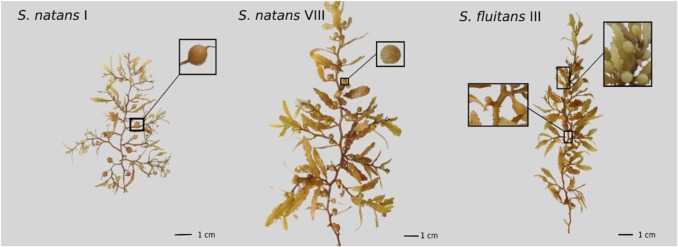
Sargassum is a type of brown seaweed that floats on the ocean’s surface throughout its entire life. In the Atlantic Ocean, three main types are most common, and they can be told apart by their size and small features like tiny spines on their stems or air bladders. Sargassum has leafy branches and small, round air-filled bladders that help it stay afloat. Moved by winds and ocean currents, Sargassum gathers into patches and long lines on the sea surface, sometimes forming very large mats. These floating habitats are important for ocean life, providing food and shelter for fish, sea turtles, seabirds, crabs, and shrimp. Some species depend on Sargassum for their entire lives. Over time, parts of the seaweed can sink, carrying organic material to deeper waters and supporting life in the deep ocean.

Morphology of the three Sargassum morphotypes present in the Atlantic Ocean

Morphology of the three Sargassum morphotypes present in the Atlantic Ocean. From Alleyne et al. (2023).

The Sargassum Crisis: Understanding and Addressing a Growing Challenge

For more than a decade, coastal regions across the Gulf of Mexico, the Caribbean, South Florida, and West Africa have been inundated by massive influxes of drifting Sargassum. These events—now known as Sargassum inundations—have disrupted tourism, damaged fisheries, buried beaches, and strained coastal infrastructure. What was once an occasional nuisance has become a persistent, basin-wide phenomenon, driven by the emergence of the Great Atlantic Sargassum Belt: a recurring accumulation of floating seaweed stretching thousands of kilometers across the tropical Atlantic.

Recent research shows that this system likely crossed a tipping point around 2010–2011, when several shifts in oceanic conditions aligned to create a new, self-reinforcing Sargassum regime (Jouanno et al., 2025). An extreme phase of the North Atlantic Oscillation (NAO) altered winds and surface currents, exporting large amounts of Sargassum from the Sargasso Sea into the eastern Atlantic—seeding areas where it had rarely thrived before. At the same time, warmer sea-surface temperatures, increased surface nutrients from vertical mixing and rivers runoff, and changes in equatorial circulations provided ideal conditions for rapid growth in the equatorial Atlantic. These combined physical and biogeochemical shifts established a new pathway and productivity hotspot that now fuels the modern Sargassum belt each year.

What Drives the Growth and Variability of Sargassum?

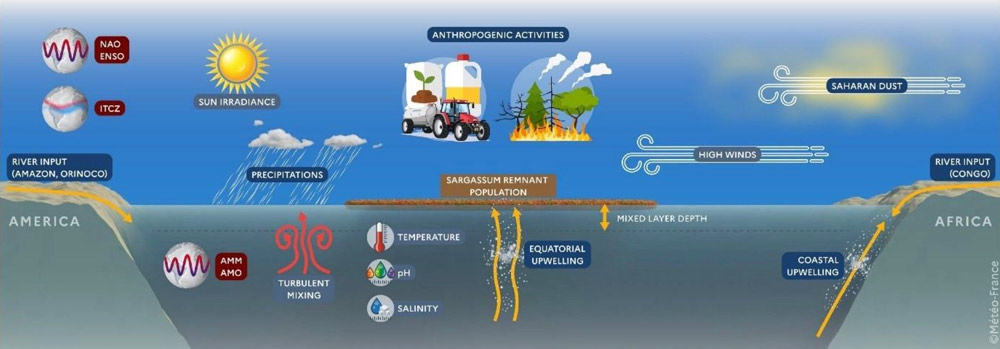
Holopelagic Sargassum grows exclusively through vegetative expansion, with rates strongly controlled by temperature, salinity, light, and nutrient availability, allowing its biomass to double within weeks under favorable conditions but slowing when waters become too warm, too cool, or too fresh. All three Atlantic morphotypes depend on high light, stable salinity, and sufficient supplies of nitrogen, phosphorus, and trace elements derived from upwelling (vertical motion of water), river plumes, atmospheric deposition, or the remineralization of older material, while shading by epiphytes or prolonged submersion can reduce growth.

These environmental controls interact with seasonal cycles and basin-scale interannual modes such as ENSO, AMM, NAO, and AMO, producing alternating periods of rapid expansion and decline and driving substantial variability from one year to the next. Across the tropical Atlantic, converging winds and currents associated with the Intertropical Convergence Zone gather small patches into larger mats during late winter and early spring, after which the northward migration of the ITCZ from May to September steers these rafts along major circulation pathways—including the North Equatorial Current and the North Equatorial Countercurrent—toward the Caribbean, Gulf of Mexico, and West Africa. Along these trajectories, continuous shifts in light, temperature, and nutrient availability determine whether Sargassum grows, decays, or disperses, ultimately shaping the biomass that reaches coastal regions each year and underscoring the need for accurate monitoring, modeling, and forecasting.

Growth and Variability of Sargassum

Possible factors of seasonal and interannual variability in Sargassum abundance in the tropical Atlantic Ocean as proposed in the literature. Blue labels: factors related to nutrients; grey labels: physical factors; red labels: global atmospheric and oceanographic phenomena. AMM: Atlantic Meridional Mode; AMO: Atlantic Multidecadal Oscillation; ENSO: El Niño-Southern Oscillation; ITCZ: Inter Tropical Convergence Zone; NAO: North Atlantic Oscillation. From Debue et al. (2025)

Impacts and Management Strategies

Massive Sargassum influxes exert cascading environmental, economic, and health impacts along the sea-to-shore pathway illustrated below. Offshore, floating mats act as biodiversity habitats supporting fish, turtles, seabirds, and complex food webs. In coastal waters, thick accumulations block sunlight, smother coral reefs and seagrass beds, and induce hypoxia or anoxia as they decompose, resulting in habitat loss and shifts in nearshore community structure. On beaches, stranded biomass releases hydrogen sulfide and ammonia, affecting public health, corroding metals, and disrupting critical infrastructure such as desalination facilities, cooling systems, and power plants. These ecological and infrastructural pressures translate into major economic losses for fisheries, tourism, and waterfront businesses, while cleanup operations demand substantial financial and human resources.

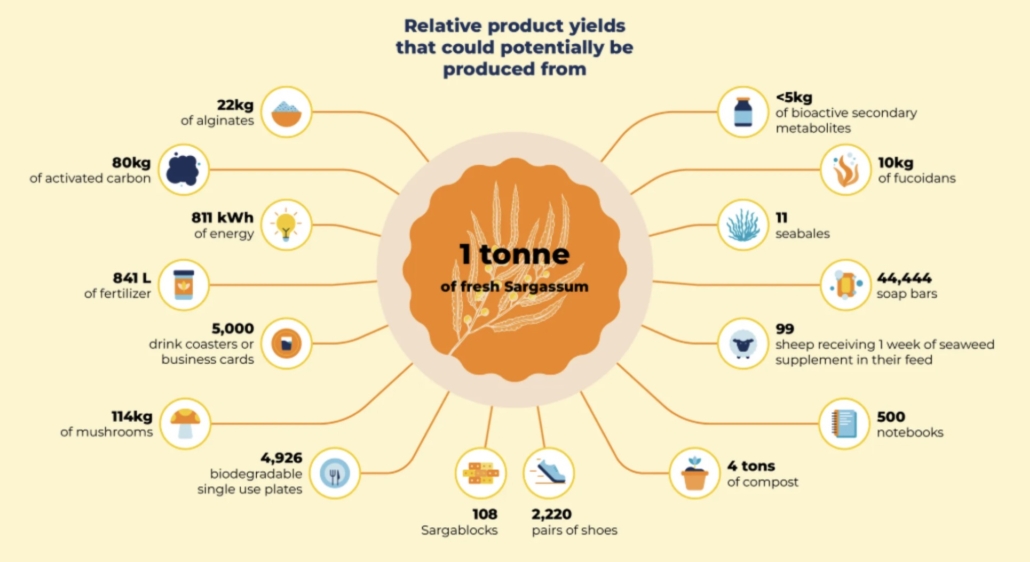
In response to these growing challenges, island and coastal states and regional organizations increasingly pursue integrated Sargassum management strategies that combine monitoring, forecasting, harvesting, and valorization. The value-chain framework—mirrored in the product-yield infographic—illustrates how Sargassum can move from nuisance to resource when managed proactively. Accurate satellite- and model-based forecasts enable early identification of harvestable biomass offshore, where material is still fresh and ecologically benine to collect. Once retrieved, stabilization and controlled storage prevent decomposition and gas release, allowing transformation into a wide range of products, from fertilizers, compost, and soil enhancers to alginates, fucoidans, activated carbon, bioplastics, construction materials such as Sargablocks, and even energy generation. Developing these pathways can help offset management costs, reduce the environmental impacts of beach cleanups, and create new economic opportunities—provided that harvesting remains ecologically responsible, processing meets safety standards, and forecasting systems remain robust enough to guide timely intervention.

Relative product yields that could be potentially be produced from 1 ton fresh sargassum

Relative product yields that could potentially be produced from 1000 kg of fresh Sargassum. Adapted from Desrochers et al. (2020)

Recommendations for Action

To address the growing Sargassum challenge, coordinated efforts between scientists, policymakers, industry stakeholders, and local communities are essential. Effective management requires both proactive planning and innovative solutions to mitigate environmental, social, and economic impacts. Key actions include:

  • Strengthening collaboration between governments, researchers, and local communities to develop adaptive management strategies.
  • Enhancing forecasting systems to provide early warnings and mitigation planning for coastal communities.
  • Developing standardized monitoring protocols and open-access data platforms to improve transparency, information sharing, and model validation.
  • Encouraging interdisciplinary research on Sargassum ecology, nutrient dynamics, and climate-related drivers to inform long-term management strategies.
  • Investing in Sargassum valorization initiatives, transforming harvested biomass into economically valuable products such as biofuels, fertilizers, and bioplastics, thereby reducing cleanup costs and generating revenue.
  • Promoting education and community engagement programs to raise awareness of Sargassum impacts and involve local stakeholders in decision-making.

By implementing these actions, coastal regions can better anticipate, manage, and utilize Sargassum blooms, turning a growing environmental challenge into an opportunity for innovation and sustainable development.

Get more information

Ocean brief: discover everything you have to know about Sargassum.

Resource: Article published on Science Direct “Understanding the Sargassum phenomenon in the Tropical Atlantic Ocean: From satellite monitoring to stranding forecast”

© Copyright - SARGASSUM INFORMATION HUB | Privacy Policy | Webdesign by Science Crunchers
Shares