SeSaM – Seasonal Sargassum Monitoring and Forecasting
Monitoring and Forecasting Sargassum in the Tropical Atlantic
Since 2011, unprecedented Sargassum blooms have affected the Caribbean and West African coasts, posing growing environmental, economic, and public-health challenges. To help territories better anticipate these events, the SeSaM project, supported by the Space for Climate Observatory (SCO) of the CNES, has delivered the first integrated European solution combining satellite monitoring, seasonal prediction, and user-friendly visualization tools.
Developed jointly by CLS (Collecte Localisation Satellites), IRD (Institut de Recherche pour le Developpement), and Mercator Ocean International, SeSaM has now reached full maturity and is increasingly adopted by European Digital twin of the Ocean (EDITO) and by the Copernicus Marine Service (CMEMS).
Sargassum Value Chain Segment : Operational Services – Monitoring and Forecasting
Duration: 2021-2025
Partners: CLS / IRD / Mercator Ocean International
Project Leads: Jean-Michel Lellouche and Gael Many (Ocean Expert 75624)
Head Office Location: Toulouse, France
Funding Source: Space for Climate Observatory (SCO) of the CNES
Location of Activities: Tropical Atlantic, Caribbean Sea, Gulf of Mexico
Project DOI: https://doi.org/10.60566/77n6t-7n818
Website Link: https://www.spaceclimateobservatory.org/fr/sesam
SeSaM unites satellite observation and advanced ocean modelling:
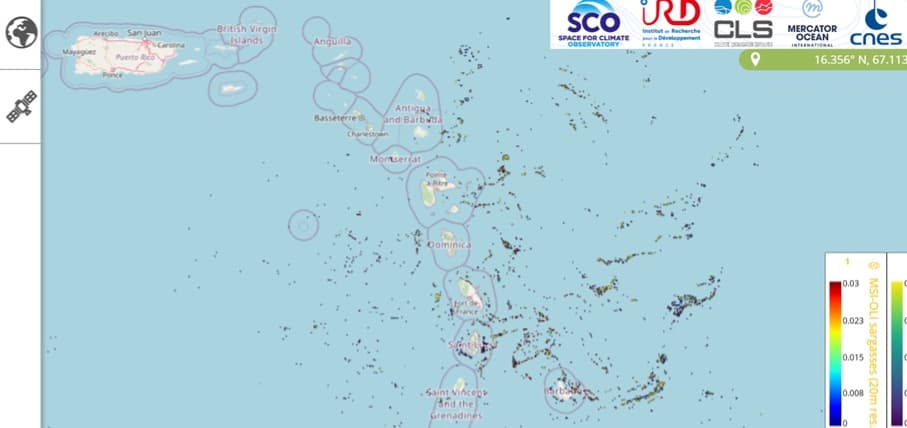
The platform developed by CLS Group is now mature and widely used. It offers:
In parallel to the SeSaM portal, the EDITO Forecast Viewer was developed for UNOC 2025 to provide an immersive, decision-oriented view of Sargassum forecasts.
It integrates:
The EDITO viewer complements the SeSaM portal by offering a more policy- and planning-oriented perspective for national authorities and regional organizations.
SeSaM has established a robust, collaborative framework for monitoring and forecasting Sargassum across the tropical Atlantic. By combining satellite detection, seasonal forecasting, and intuitive visualization tools, the project offers territories and organizations valuable visibility months ahead of potential strandings. Through the Sargassum Information Hub, these operational products are now more easily accessible to managers, agencies, and the scientific community, supporting informed decision-making and improving preparedness across affected regions.
This website development received funding from the European Union. Its contents are the sole responsibility of the HUB partners and do not necessarily reflect the views of the European Commission.
The HUB is being updated as an action of the GEO Blue Planet Sargassum Working Group.