Management
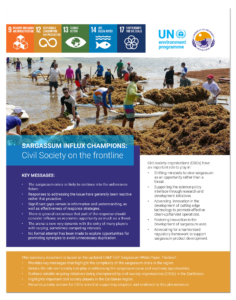
Effective Sargassum management requires coordinated, science-based actions that address the entire sea-to-shore continuum, from early detection offshore to mitigation and valorization on land. Because the timing, volume, and condition of incoming biomass vary widely, management strategies rely on integrated monitoring and forecasting systems that combine satellite observations, oceanographic models, and local reporting to provide timely alerts and guide interventions. When arrivals are predicted early, coastal authorities can deploy targeted offshore collection, channel mats away from sensitive habitats, or prepare beach-management operations that minimize ecological damage and public-health risks. Increasingly, management also includes the development of sustainable value chains—stabilizing, processing, and transforming harvested Sargassum into useful products—to offset cleanup costs and reduce waste. Successful approaches therefore depend on cross-sector collaboration, standardized monitoring, accessible forecasting tools, and investment in safe, scalable valorization pathways that help coastal communities adapt to recurrent Sargassum events.